Key Takeaways
- The ancient canons of Shilpa Shastra prescribe precise mathematical proportions (Talamana system) for stone carving that balance structural equilibrium and divine aesthetics.
- Fine-grained Vindhyan sandstone possesses the rare combination of workable softness during quarry moisture retention and hardening upon prolonged atmospheric curing.
- Traditional pierced jali screens function as passive architectural climate regulators, accelerating natural air breezes via the Venturi effect while cutting harsh solar glare.
- While CNC milling handles preliminary roughing, authentic intricate deep-undercuts, feather plumage, and facial expressions require hundreds of hours of hereditary hand chiseling.
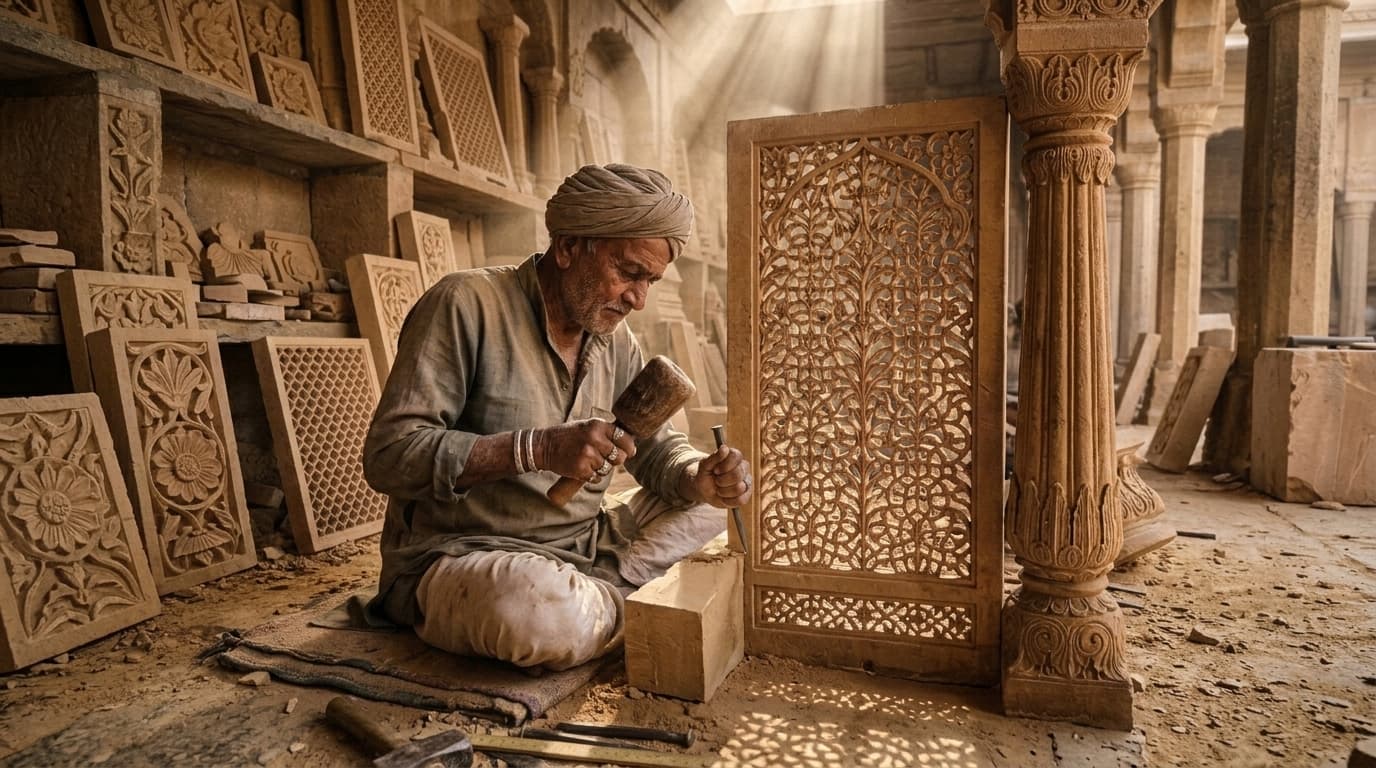
In an era dominated by rapid mass manufacturing and artificial 3D printing, the centuries-old art of stone sculpting remains one of the last bastions of pure human craft. In the historic stone carving belts of Sikandra and Dholpur in Rajasthan, hereditary master artisans continue a sacred lineage dating back over thirty generations. Guided by the ancient Sanskrit shlokas of the Shilpa Shastra, these craftsmen transform unyielding multi-tonne quarry boulders into lifelike feathers, delicate floral arabesques, and ethereal pierced jalis that play with sunlight and breeze.
1. The Sacred Lineage of Rajasthan Stone Ateliers
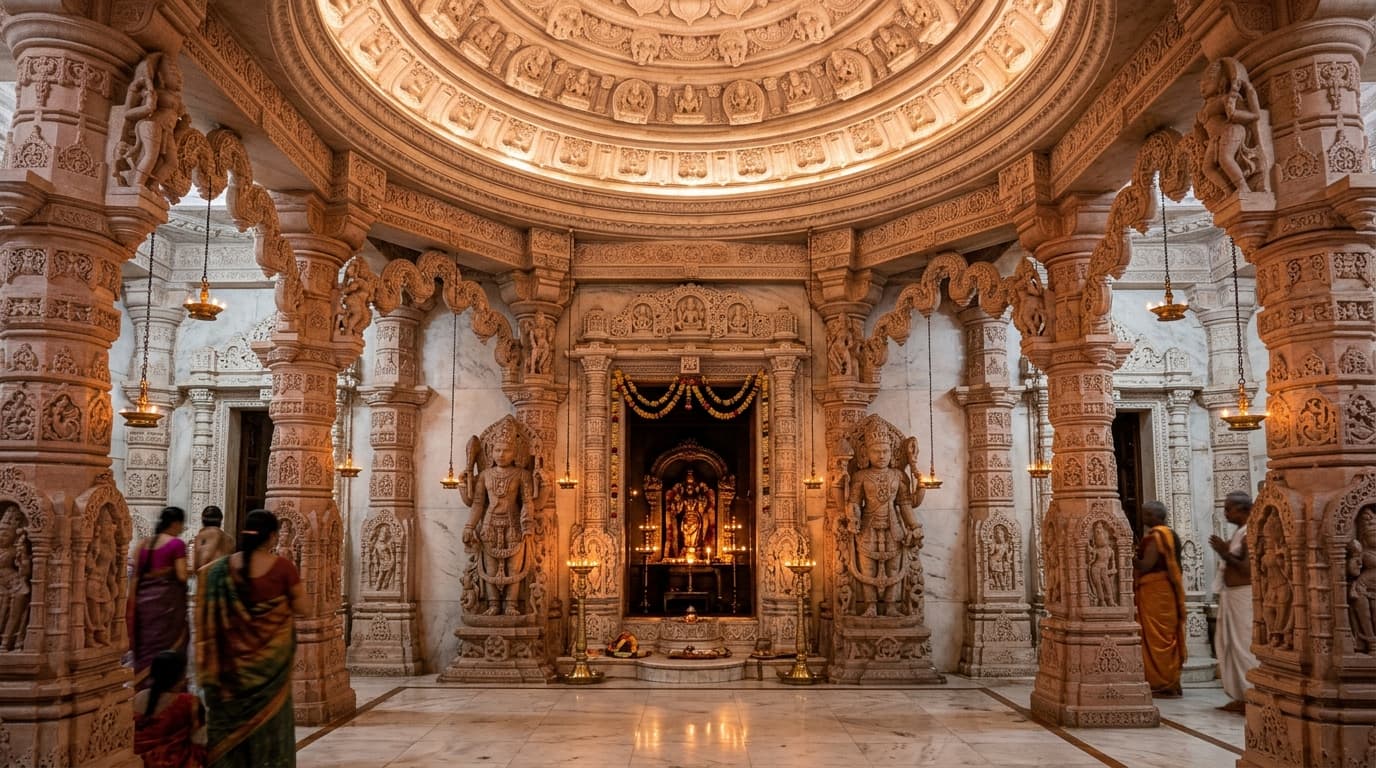
Stone carving in Rajasthan is not merely an occupation; it is a hereditary spiritual discipline handed down from father to son. Craftsmen belong to historic stone-mason guilds known as 'Silawats' and 'Sompuras'—the same artisan families that chiseled the sacred Jain temples of Dilwara, the palaces of Jaipur and Udaipur, and modern marvels like the Akshardham temples in Delhi and Gandhinagar.
Before striking the first chisel blow upon a fresh quarry block, the master sculptor performs a traditional 'Shila Puja' (reverence to the stone), seeking permission from the mineral spirit and discerning internal fault lines through pitch resonances produced by gentle wooden mallets.
2. The Anatomy of Carving Stone: Why Dholpur Sandstone Excels
Not all sandstone can sustain delicate relief carving. Coarse sandstones crumble when struck with fine steel points, while granites are too brittle for deep undercuts. Authentic Dholpur Beige and Bansi Pink sandstone possess unique physical qualities that make them the sculptor's dream medium:
- Quarry Sap (Moiety Moisture): When freshly extracted from deep underground strata, the stone contains natural moisture that makes it supple and receptive to fine chiseling.
- Case Hardening: As the completed sculpture is exposed to open air and sunlight over months, the internal silica migrates to the surface and crystallizes, creating a rock-hard weather-resistant outer skin.
- Homogeneous Grain Structure: Micro-fine quartz particles ensure that chisel strikes do not produce uncontrolled spalling or micro-cracks along hidden bedding planes.
3. Jali Screens: Passive Climate Control & Light Geometry
The sandstone jali (perforated lattice screen) is one of Indian architecture's most brilliant inventions. Long before electrical air conditioning, palace courtyards relied on jalis for thermal regulation and optical privacy.
By funneling warm exterior breezes through thousands of small geometric perforations, the jali utilizes the Venturi principle—compressing the air volume and releasing it into the interior courtyard at a noticeably cooler velocity. Simultaneously, the screen fractures blinding desert sunlight into soft, dappled illumination, casting mesmerizing animated shadows across interior marble floors throughout the day.
Passive Architectural Genius
A well-designed 50mm sandstone jali can reduce direct solar heat gain by up to 55% while maintaining natural air circulation and providing complete one-way visual privacy.
4. Masterworks: The Monolithic Peacock & Royal Garden Lantern
Among the most sought-after architectural centerpieces created at our ateliers are our signature monolithic hand-carved stone articles:
The Monolithic Peacock: Sculpted from a single solid block of Dholpur stone without adhesive joints, the peacock's delicate eye feathers and curving neck are hollowed out using miniature gouge chisels. Each quill is individually striated to catch the morning dew and sunlight.
The Royal Stone Lantern (Diya Stambha): Standing 4 to 8 feet high, these traditional multi-tiered garden lanterns feature pierced lattice chambers designed to house ambient electric lamps or traditional oil lamps, illuminating pathways with intricate geometric shadow projections.
5. CNC Precision Meets Artisanal Soul: The Modern Atelier
At Garg Corporation Ltd., we do not view modern CNC machinery as a replacement for human mastery; rather, we orchestrate a harmonious marriage between high technology and traditional craft.
Our 8-axis laser-guided CNC profiling centers handle the hazardous, physically exhausting task of 3D bulk material removal, achieving exact dimensional tolerances specified by architectural CAD drawings. Once the rough silhouette is formed, the workpiece is transferred to our master Shilpkar artisans, who spend hundreds of meticulous hours breathing life into the stone with handheld steel chisels, refining expressions, undercut drapery, and textural nuance that no algorithm can replicate.
Every hand-carved sandstone sculpture or jali screen is a one-of-a-kind original work of art carrying the enduring spirit of India's classical heritage. Browse our curated Sandstone Articles gallery or commission a bespoke architectural sculpture for your residence today.
Frequently Asked Questions
What is the Shilpa Shastra, and how does it influence stone carving?
The Shilpa Shastras are ancient Sanskrit treatise manuals on visual arts, sculpture, and sacred iconography. They define the Talamana measurement system, stone grain orientation, and cosmological proportions required to ensure sculptures possess physical balance, structural stability, and sacred aesthetic harmony.
How long does it take to hand-carve a monolithic sandstone peacock sculpture?
A life-sized monolithic peacock sculpture (approximately 4 to 5 feet in height with full open plumage) carved from a single 2-tonne block of Dholpur sandstone requires between 45 to 60 days of continuous hand chiseling by senior hereditary master artisans.
Can custom jali screens be fabricated to bespoke CAD architectural drawings?
Absolutely. Our design studio translates modern DWG/CAD architectural patterns—ranging from Islamic geometric octagrams and traditional Mughal florals to contemporary abstract fractals—into precision-calibrated sandstone jali panels with customizable thickness from 30mm to 75mm.