Key Takeaways
- Parchin Kari requires gemstones to be hand-ground using wire bow drills (Tara-charkhi) with emery paste to exact 2.5mm depths, creating tolerances under 0.05mm.
- Semi-precious stones used include Afghan lapis lazuli (royal blue), Ural malachite (emerald green), Persian turquoise (sky blue), and Indian carnelian (fiery amber).
- Traditional natural mastic resin (prepared from natural tree gums, unslaked marble dust, and linseed oil) permanently bonds the gemstones without synthetic yellowing.
- Bespoke Parchin Kari inserts elevate luxury villa foyer medallions, dining tabletop consoles, and executive boardroom focal panels into priceless museum-grade heirlooms.
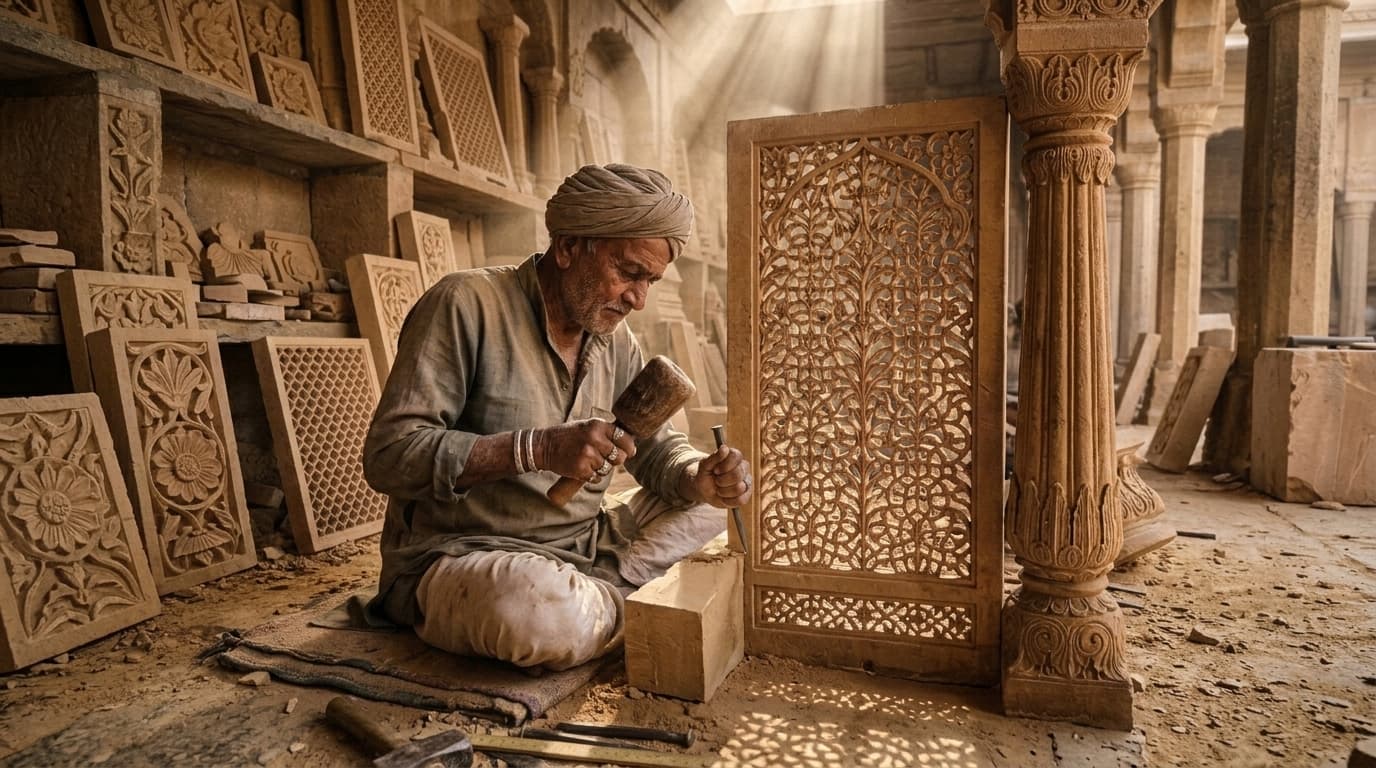
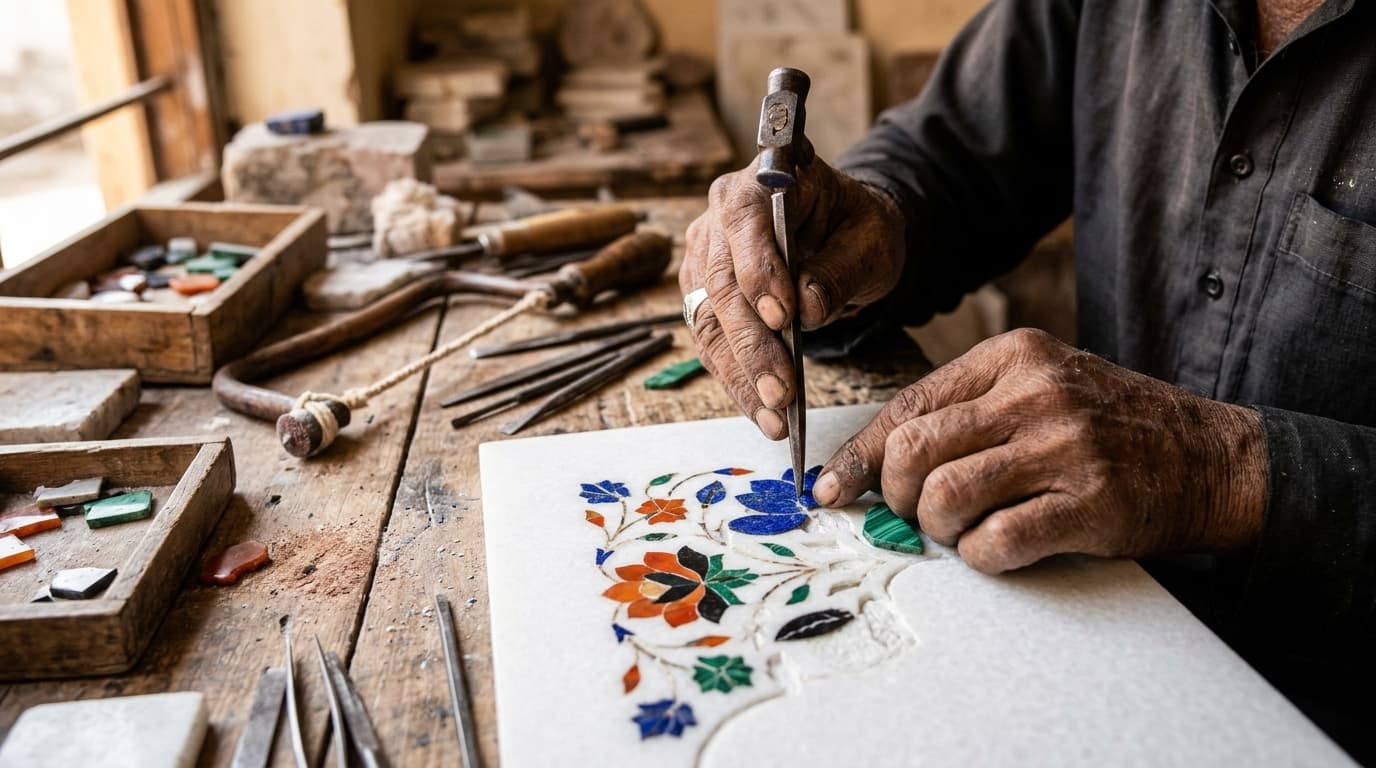
Step inside an artisan atelier in Sikandra or Agra, and you will hear the rhythmic hum of the wire bow drill (Tara-charkhi) shaping microscopic slivers of deep blue Afghan lapis lazuli, vivid green malachite, and fiery orange carnelian. This is Parchin Kari—the royal Mughal art of stone intarsia, where cold mineral jewels are transformed into blooming garden flowers embedded permanently into pure white marble and sandstone. In this artisan monograph, we document the technical secrets of India's most prestigious lapidary tradition.
1. Historic Roots: Florence Pietra Dura Meets Mughal Parchin Kari
In the early 17th century, Florentine lapidary masters under the Medici family traveled to the Mughal imperial court, introducing the Italian art of 'pietre dure' (hard stones). In the ateliers of Agra and Sikandra, Indian master carvers adapted this craft into Parchin Kari, fusing it with Persian arabesques and Indian botanical motifs.
The zenith of this craft is immortalized across the cenotaph screens of the Taj Mahal, where single carved marble flowers contain over 60 individual semi-precious stone petals cut with such surgical accuracy that seams between stones are invisible to the naked human eye.
Artisan Precision
A master Parchin Kari artisan takes up to 40 hours of patient hand-grinding to shape, bevel, and embed the 50 microscopic gemstone petals comprising a single 3-inch floral medallion.
2. Gemstone Mineralogy: Hardness Matching Between Marble and Jewels
One of the greatest engineering challenges in stone inlay is matching the physical hardness of the inlay gems with the marble base. Makrana marble has a Mohs hardness of 3.0 to 3.5, while inlay gemstones (such as quartz, jasper, and carnelian) have a Mohs hardness of 6.5 to 7.0.
If an artisan applies unequal pressure during final surface leveling, the softer marble wears away faster than the hard gemstones, creating uneven ridges. Hereditary masters use graded natural emery powders (Kuran) mixed with water on flat sandstone blocks to achieve an optically flat, mirror-polished surface.
| Gemstone Variety | Natural Mineral Color | Geological Source | Mohs Hardness |
|---|---|---|---|
| Lapis Lazuli | Deep Royal Azure Blue with Pyrite flecks | Badakhshan (Afghanistan) | 5.5 – 6.0 |
| Malachite | Emerald Green with concentric banding | Ural Mountains / Africa | 3.5 – 4.0 |
| Carnelian | Translucent Fiery Orange-Red | Deccan Traps (Gujarat, India) | 6.5 – 7.0 |
| Jasper (Yellow & Red) | Opaque Ochre & Brick Crimson | Rajasthan, India | 6.5 – 7.0 |
| Turquoise (Firoza) | Sky Blue with dark matrix veins | Nishapur (Persia / Iran) | 5.0 – 6.0 |
| Mother of Pearl | Iridescent Pearl White with rainbow luster | Indian Ocean Mollusks | 3.5 |
3. The Bow Drill & Emery Wheel: Traditional Micro-Lapidary Craftsmanship
Every gemstone starts as a rough mineral pebble. The artisan slices the gem into thin 2.5mm wafers using a hand-tensioned wire saw. Using a traditional wooden bow drill and iron emery wheel, the gem is shaped petal-by-petal, with edges slightly beveled inward.
The artisan places the shaped gemstone petal onto the marble face, traces its exact perimeter with a hardened steel scriber, and uses ultra-fine chisels (Chheni) to hollow out an exact recess. The inward bevel ensures that when the gem is pressed into place, it wedges mechanically into the marble.
4. Natural Resin Formulations: Centuries of Non-Yellowing Bonding
Modern epoxy glues inevitably oxidize, turn yellow, and fail under direct sunlight within 15 to 20 years. Hereditary Sikandra ateliers still prepare their bonding mastic from an ancient secret formula passed down through generations.
The formulation combines unslaked lime (Chuna), pulverized white marble dust (Sang-e-Marmar powder), natural pine gum resin (Gond), and boiled linseed oil. This organic mastic creates a chemical bond that cures through slow carbonation, remaining flexible and permanently white for centuries.
5. Architectural Applications: Grand Foyer Medallions & Wall Insets
In contemporary high-end luxury interiors, Parchin Kari is specified for grand entryway floor medallions, central courtyard fountain borders, custom dining tables, and executive fireplace surrounds.
Framed within Dholpur sandstone or Makrana marble floors, these bespoke gemstone inlays become irreplaceable conversation pieces that elevate a private residence into a private museum.
Parchin Kari is living history—a royal craft where geology, art, and surgical patience converge to create immortal botanical tapestries in stone. Commission bespoke stone inlay medallions and heritage tabletops at Garg Corporation Ltd.
Frequently Asked Questions
What is the difference between Italian Pietra Dura and Mughal Parchin Kari?
While both techniques involve embedding precisely cut stones into a stone matrix, Italian Pietra Dura (born in Renaissance Florence) often focused on pictorial landscapes, portraits, and still-life scenes using dark marble bases. Mughal Parchin Kari (perfected in Agra and Sikandra under Emperor Shah Jahan) refined the art into intricate floral arabesques, flowering vines, and calligraphic geometric scrolls set into luminous white Makrana marble and fine-grained sandstone, achieving microscopic tolerances where single flower blossoms contain up to 60 individual gemstone shards.
Can Parchin Kari marble inlay be used on outdoor surfaces or dining tabletops?
Yes. Because genuine semi-precious minerals (lapis lazuli, jasper, carnelian, onyx) possess high Mohs mineral hardness (between 6.0 and 7.5), they are completely scratch-resistant. When set into marble using traditional water-resistant mastic and sealed with penetrating fluoropolymer impregnators, Parchin Kari tabletops endure daily domestic dining, hot coffee mugs, and outdoor courtyard conditions.
How do you distinguish authentic hand-carved stone inlay from cheap synthetic resin replicas?
Synthetic imitations use cheap colored epoxy or polyester resins poured into machine-routed grooves; under magnification, they show air bubbles, soft plastic texture, and fade or discolor under UV light within two years. Authentic Parchin Kari uses 100% natural cold crystalline gemstones hand-cut with beveled edges; each gemstone petal exhibits unique natural geological banding and cool mineral touch.