Key Takeaways
- Explosive blasting in stone quarries causes invisible micro-shattering that leads to catastrophic hairline cracking years later under atmospheric weathering.
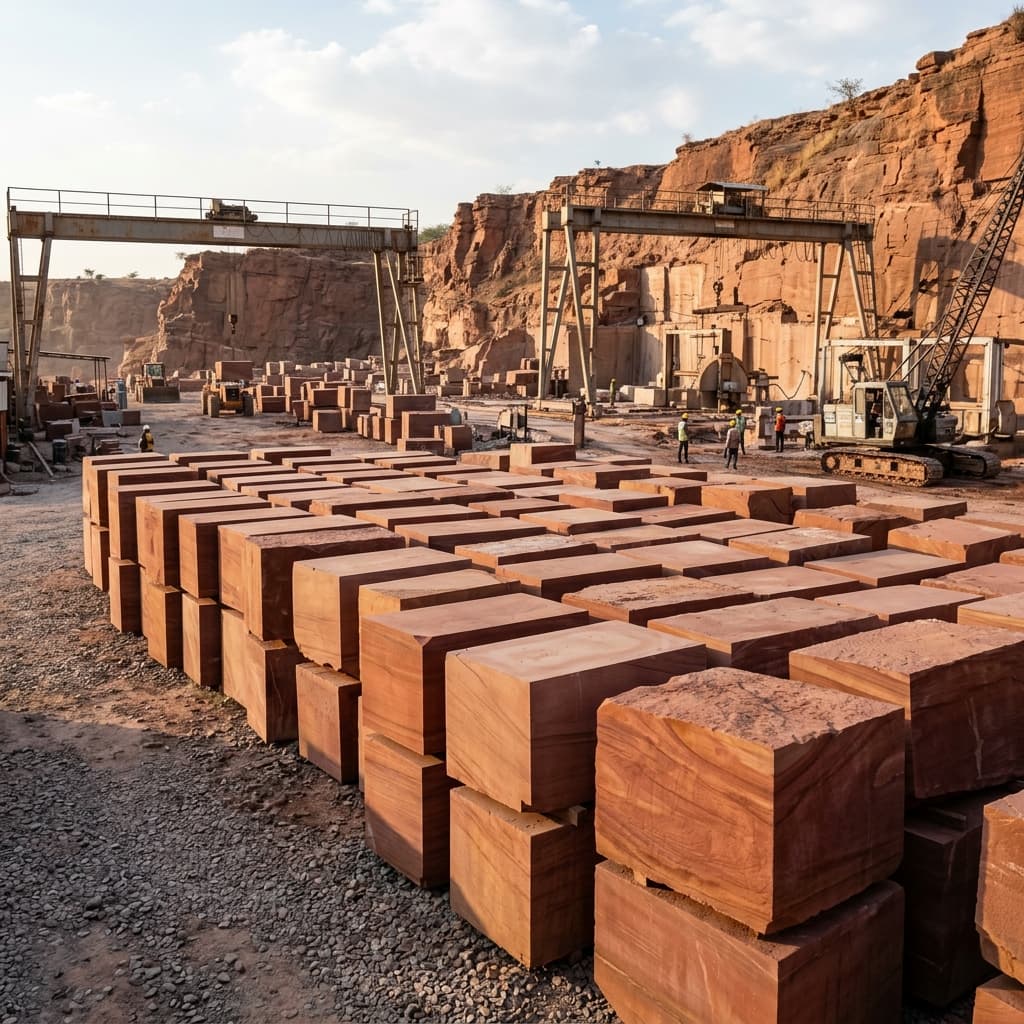
- At our Dholpur concession, we employ zero-blast mechanical extraction using continuous diamond wire saws and non-explosive hydraulic expanding jacks.
- Ultrasonic pulse velocity testing on freshly extracted blocks verifies uniform internal density (2.45–2.52 g/cm³) before blocks are released for gangsaw slicing.
- Monolithic 30-tonne blocks are dressed with automated squaring machines to ensure maximum yield and zero-stress planar slabs.
The longevity of a natural stone facade or temple pillar is not determined in the architect's studio or at the construction site—it is decided at the quarry face. In an industry where rogue miners frequently use explosive dynamite to blast stone rapidly from the earth, Garg Corporation Ltd. has maintained a strict zero-blasting mandate since 1953. In this technical exposé, we take you deep into our Dholpur concession to reveal the surgical precision behind modern monolithic stone extraction.
1. The Danger of Explosives: Why Micro-Fracturing Occurs
When natural sandstone is quarried using dynamite, the instantaneous compressive shockwave reverberates through the entire geological formation. Although the extracted block may appear intact to the naked eye, the internal quartz crystal lattice has sustained millions of microscopic fissures.
When these compromised stones are later cut into thin facade panels and exposed to winter freeze-thaw cycles or summer heat expansion, the micro-fractures propagate, resulting in spalling, edge flaking, and catastrophic structural failure. Zero-blast extraction is the only way to guarantee multi-generational facade integrity.
2. Diamond Wire Sawing & Hydro-Bag Separation
At our Dholpur quarry benches, we extract stone through gentle, mechanical slicing:
- Core Drilling & Wire Threading: Perpendicular intersecting holes are diamond-drilled into the bedrock to thread a continuous loop of high-tensile steel wire studded with synthetic diamond beads.
- Water-Cooled Slicing: The diamond wire spins at 35 meters per second, slicing cleanly through solid bedrock at a rate of 4 to 6 square meters per hour while being flushed with recycled cooling water.
- Hydro-Bag Bench Displacement: High-pressure water bladders (Hydro-Bags) are inserted into the saw cut, exerting thousands of tonnes of uniform hydraulic pressure to gently tip the 100-tonne bench away from the quarry wall without shock.
3. Selecting Virgin Strata: Top Benches vs Deep Sound Rock
Surface stone exposed to centuries of atmospheric weathering often exhibits porous, soft layers. At Dholpurstones, top overburden rock is set aside for secondary civil road base aggregate.
Our architectural grade blocks are extracted exclusively from deep, unweathered virgin strata located 15 to 30 meters beneath the surface, where the natural Vindhyan sandstone achieves maximum quartz density (2.48–2.52 g/cm³) and minimum water absorption (< 1.15%).
Geological Excellence
Deep bench sandstone has been under geological lithostatic pressure for 500 million years, creating ultra-dense siliceous matrices that resist the harshest atmospheric conditions.
4. Geotechnical Ultrasonic Verification at Quarry Face
Before any raw block is transported to our gangsaw mills, it undergoes Ultrasonic Pulse Velocity (UPV) scanning conforming to ASTM C597. Transducers placed on opposite faces of the block send high-frequency acoustic waves through the stone.
A velocity reading above 4,200 meters per second confirms that the block is 100% monolithic, homogeneous, and completely free from internal voids, clay pockets, or hidden hairline fault lines.
5. Zero-Waste Processing & Environmental Stewardship
Responsible quarrying requires rigorous environmental management. 100% of the cooling water used in our wire sawing operations is channeled into settling tanks, filtered, and continuously recirculated in a closed-loop system.
Stone offcuts and slurry are repurposed into eco-friendly engineered pavers and soil enrichment minerals, ensuring zero environmental landfill waste.
True architectural luxury begins with uncompromised geological integrity. When you specify stone from Garg Corporation Ltd., you are guaranteed blocks that were extracted with scientific reverence for the rock. Schedule a private quarry inspection tour with our engineering team today.
Frequently Asked Questions
Why does explosive quarry blasting ruin natural building stone?
Commercial dynamite detonations generate shockwaves exceeding 6,000 meters per second. While blasting dislodges stone quickly and cheaply, the violent shockwave fractures the delicate siliceous bonds between quartz grains up to 20 meters deep into the bedrock. These micro-cracks absorb rainwater and cause premature spalling and cracking after installation.
What is the largest monolithic sandstone block you can extract?
Using our multi-wire bench cutters, we routinely extract raw monolithic blocks weighing between 25 to 35 metric tonnes, with dimensions up to 3.5 meters long, 2.0 meters wide, and 1.8 meters high. Such giant blocks are essential for monumental monolithic peacock sculptures and monolithic temple pillars.
Can architects and project teams inspect raw blocks at the quarry?
Yes. We welcome architects, structural engineers, and private clients to our Dholpur and Sikandra quarries to inspect raw block benches, perform acoustic resonance checks, and hand-tag specific block consignments for their projects.