Key Takeaways
- Crystalline Makrana marble (98%+ calcite purity) reflects 85% of solar radiation, while surrounding Dholpur sandstone colonnades absorb ambient heat, creating a microclimatic cool sanctuary in palatial courtyards.
- Pairing calcitic marble with siliceous sandstone requires engineered non-rigid jointing compounds to absorb slight differential thermal expansion coefficients (marble ~5.5 x 10^-6/K vs sandstone ~8.0 x 10^-6/K).
- Authentic historic monuments—including the Taj Mahal, Amber Palace, and Umaid Bhawan—stand as centuries-old empirical proof of the durability of marble and sandstone assemblies.
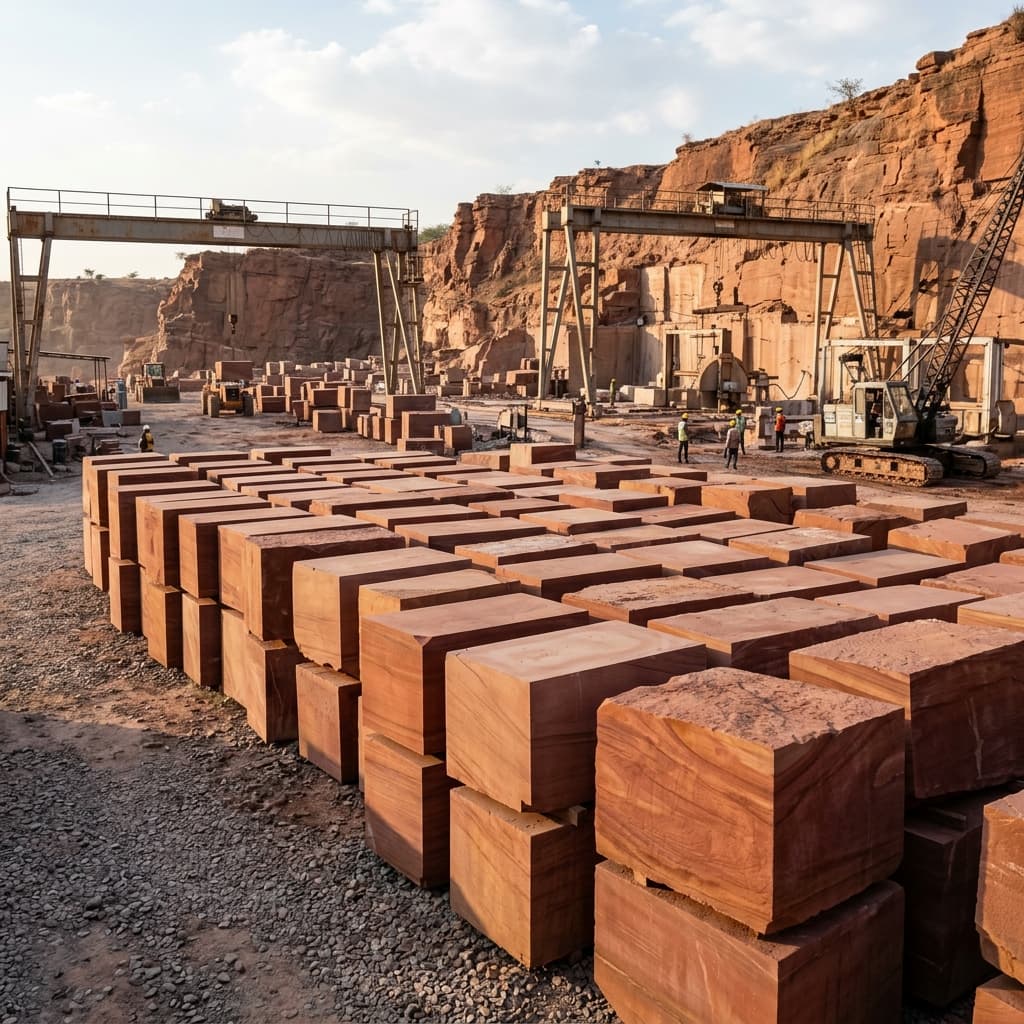
- Sourcing from proprietary certified quarry benches guarantees authentic mineral grain compatibility, preventing iron-leaching or chemical staining between adjacent stone varieties.
The golden age of Indian royal architecture produced some of humanity's most breathtaking structures by orchestrating a masterclass in material duality: the luminous, crystalline radiance of Makrana white marble juxtaposed against the warm, earthy permanence of Dholpur beige and Agra red sandstone. From the majestic Diwan-i-Am of the Red Fort to the water pavilions of Udaipur, this interplay represents the highest pinnacle of stone engineering. In this technical monograph, we analyze the physical, thermal, and structural rules that govern this legendary pairing.
1. Heritage Precedence: Taj Mahal, Amber Palace & Umaid Bhawan
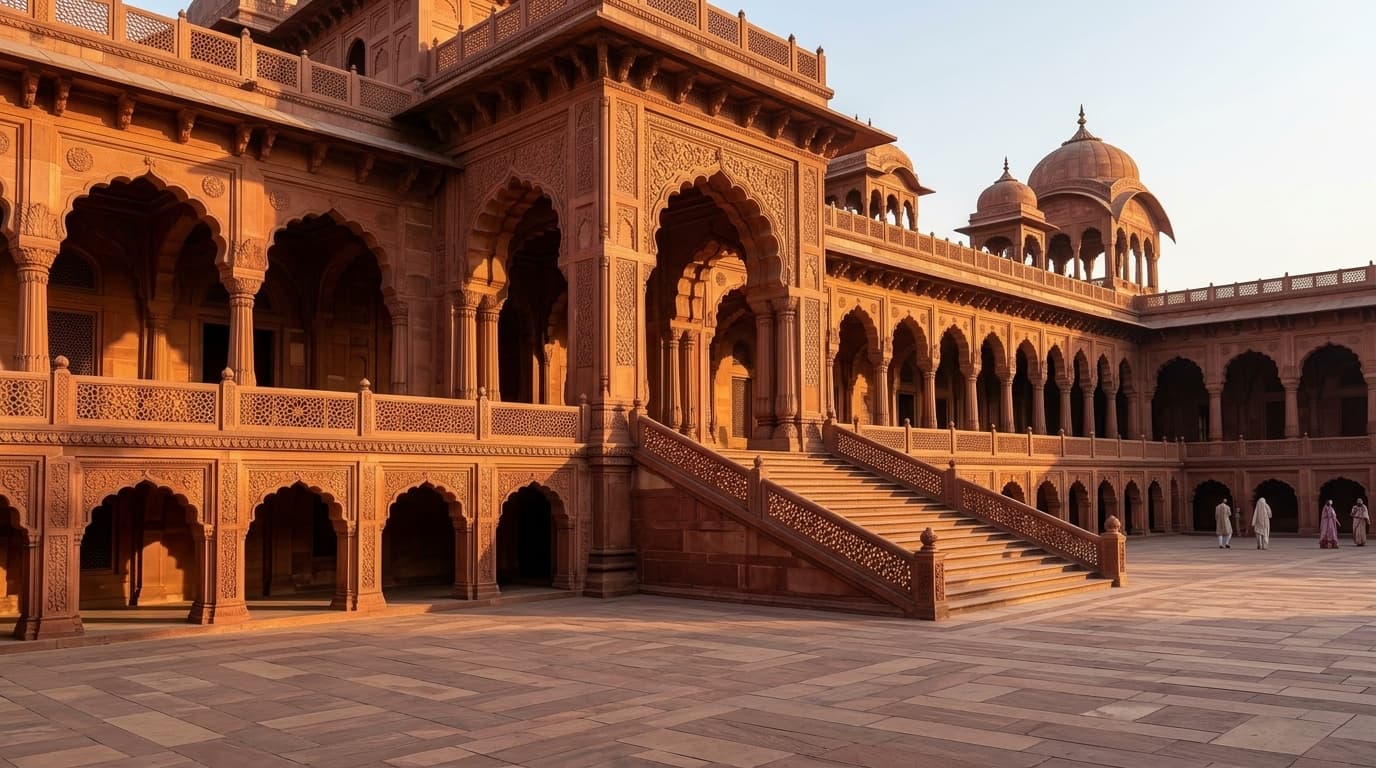
Centuries before modern composite building materials existed, royal Indian architects solved severe desert heat through mineral selection. At the Taj Mahal complex, monumental exterior gates and secondary mosques were sculpted from iron-rich Agra Red sandstone, framing the central mausoleum chiseled exclusively from pure Makrana marble.
Similarly, at the Amber Palace in Jaipur and Umaid Bhawan Palace in Jodhpur, master masons alternated between Chittor and Makrana marble for ceremonial flooring and Chittorgarh/Dholpur sandstone for intricately carved brackets, jharokhas, and fluted exterior colonnades. These structures have withstood over 400 years of extreme monsoon cycles and scorching 48°C desert summers without structural failure.
Architectural Precedence
Historic monuments demonstrate that authentic Dholpur sandstone and Makrana marble endure for half a millennium when installed with proper lime-mortar breathing joints.
2. Geological Synergy: Calcitic Metamorphic Marble vs Siliceous Sandstone
To successfully combine marble and sandstone in contemporary luxury villas, architects must understand their distinct geological origins. Makrana marble is a metamorphic rock formed by the high-pressure recrystallization of ancient limestone, yielding 98% pure interlocking calcite crystals with ultra-low water absorption (<0.15%).
Dholpur sandstone is a sedimentary rock formed from ancient riverine quartz sand grains cemented by silica. Because both stones possess superior hardness and chemical stability, they do not react adversely with each other when bonded with breathable, non-alkaline mortars.
| Geotechnical Parameter | Makrana White Marble | Dholpur Beige Sandstone |
|---|---|---|
| Rock Classification | Metamorphic (Recrystallized Calcite) | Sedimentary (Siliceous Quartzite) |
| Compressive Strength | 75.0 – 85.0 MPa | 68.4 – 74.2 MPa |
| Water Absorption | < 0.15% (Extremely dense) | < 1.15% (Ultra-low for sandstone) |
| Solar Reflectance Index (SRI) | 85 – 92 (Maximum solar reflection) | 78 – 82 (High albedo, cool touch) |
| Thermal Expansion Coeff. | ~5.5 x 10^-6 / Kelvin | ~8.0 x 10^-6 / Kelvin |
| Surface Workability | Mirror polish, high gloss | Honed, fluted, shot-blasted, carved |
3. Thermal Mechanics: Microclimatic Evaporative Cooling in Palatial Courtyards
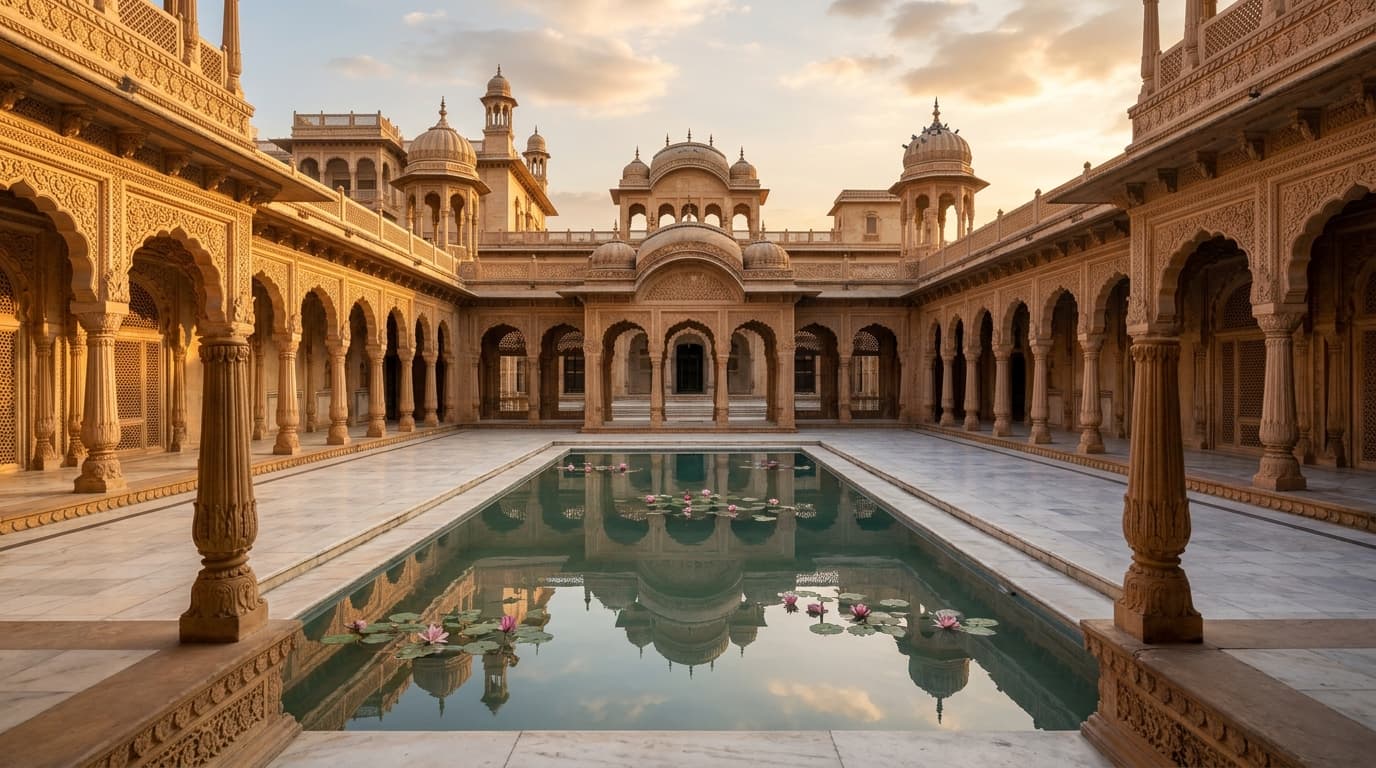
In an open-air courtyard, white marble pavings act as a giant thermal mirror, bouncing shortwave solar radiation back into the atmosphere and preventing heat buildup. Surrounding Dholpur sandstone arcades provide dense thermal mass, slowly storing heat and dampening daily temperature swings.
When paired with a central sandstone reflection pool or fountain basin, gentle evaporative breezes wash across the cool marble floor, naturally dropping ambient courtyard temperatures by 4°C to 7°C compared to surrounding paved streets.
4. Joint Engineering: Managing Differential Expansion & Breathability
Because marble and sandstone possess slight differences in thermal expansion coefficients, rigid synthetic epoxy grouting across large transition seams can induce shear micro-cracking over seasons of extreme temperature fluctuations.
We specify flexible polymer-modified cementitious grouts (CG2 WA classified) or elastic neutral-cure polyurethane movement joints placed every 4 to 5 meters at material transitions. Slabs should always be back-primed with an SBR polymer slurry to block sub-floor efflorescence salts from migrating into the marble face.
5. Contemporary Applications: Luxury Villa Colonnades & Lotus Reflection Pools
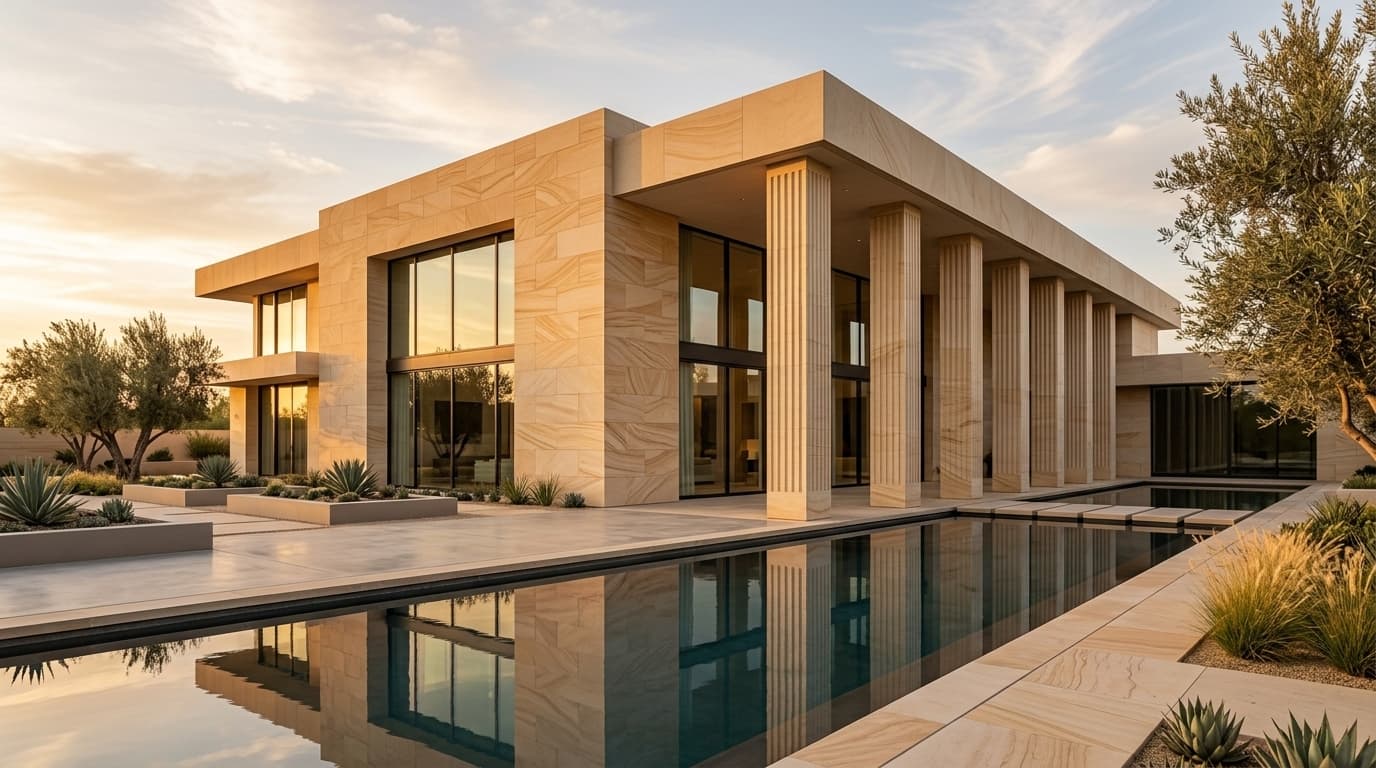
Modern luxury residences combine this royal aesthetic by specifying seamless large-format Makrana or Kishangarh white marble floor slabs inside, flowing outward past sliding glass partitions onto shaded Dholpur sandstone verandahs.
Carved sandstone water walls cascading into white marble reflecting pools create breathtaking biophilic tranquility in private estate gardens, anchoring contemporary minimalist architecture to centuries of Indian royal heritage.
The timeless dialogue between white marble and warm natural sandstone remains the ultimate architectural expression of luxury, majesty, and climatic intelligence. Garg Corporation Ltd. collaborates with discerning architects to quarry, calibrate, and sculpt custom marble and sandstone assemblies.
Frequently Asked Questions
Can white marble and sandstone be used adjacent to each other outdoors without mineral staining?
Yes, provided authentic high-silica sandstone (such as certified Dholpur Beige) and pure calcitic marble (such as Makrana) are specified, and installed with non-staining, efflorescence-free white cement or polymer adhesives. Ferrous sandstone varieties with unbonded iron nodules should be avoided near white marble, as rainwater can leach rust streaks into the marble pores.
Why did Mughal and Rajput emperors combine Agra Red / Dholpur sandstone with Makrana marble?
The architectural contrast served both aesthetic and climatic functions: the robust sandstone formed monumental defensive gates, bastions, and shading arcades that absorbed intense solar heat, while luminous white marble was reserved for elevated imperial pavilions (Diwan-i-Khas), royal baths (Hammam), and central reflecting courtyards where its radiant purity stayed cool under bare feet.
What maintenance is required for outdoor marble and sandstone courtyard pavements?
Outdoor marble and sandstone courtyards should be washed periodically with pH-neutral stone cleansers. Acidic cleaners (like muriatic acid or citrus solutions) must strictly never be used on marble as they etch the polished calcite crystals. Applying a breathable silane-siloxane impregnator every 3 to 5 years protects against organic stains while allowing sub-floor vapor transmission.