Key Takeaways
- Indian Makrana marble contains up to 98% calcium carbonate with an interlocking crystalline saccharoidal structure, resulting in water absorption below 0.15% (compared to 0.40–0.60% in Italian Carrara/Statuario).
- Italian marble requires resin-netting (epoxy mesh backing) due to microscopic structural fissures; Indian marble is dense monolithic stone that requires zero mesh backing.
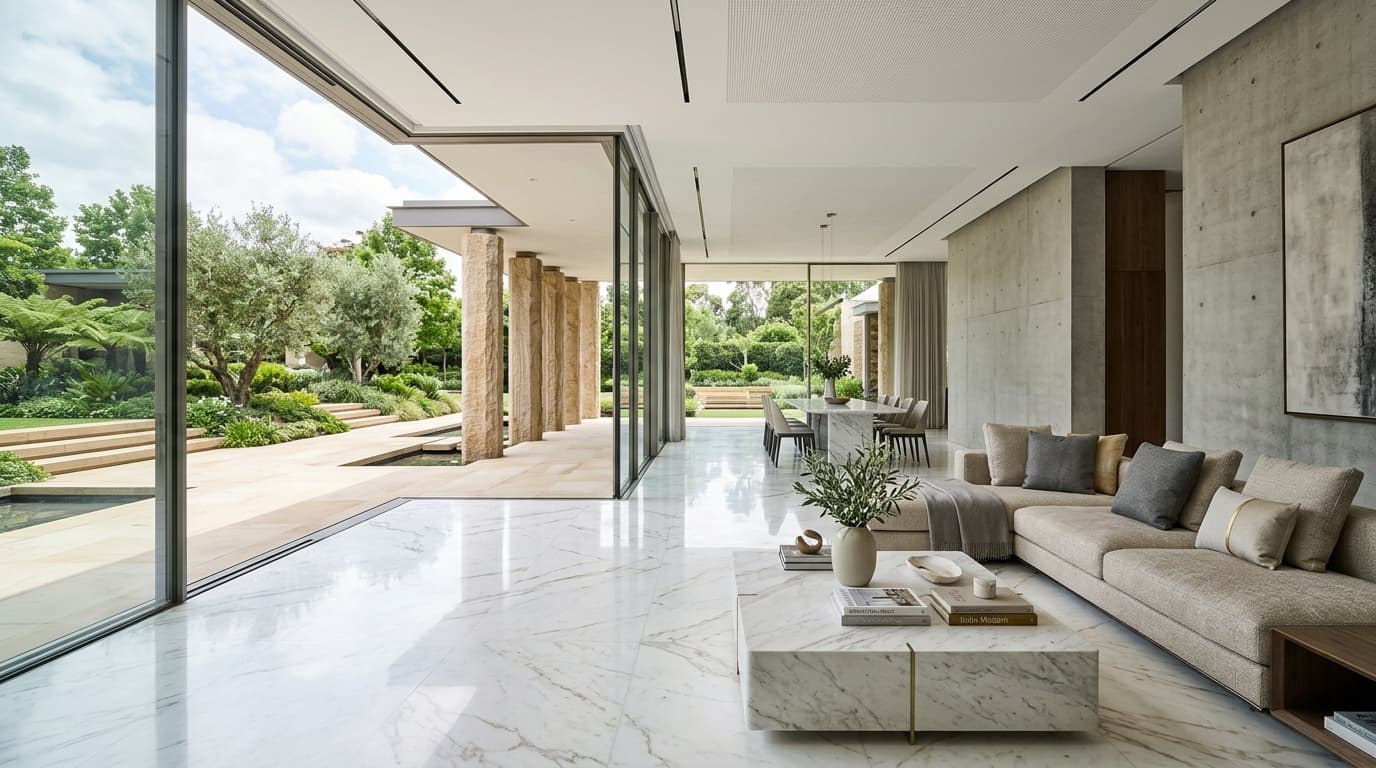
- Indian marble does not absorb yellowing from sub-floor cement moisture or oil spills, developing a higher mirror polish the longer it is walked upon over decades.
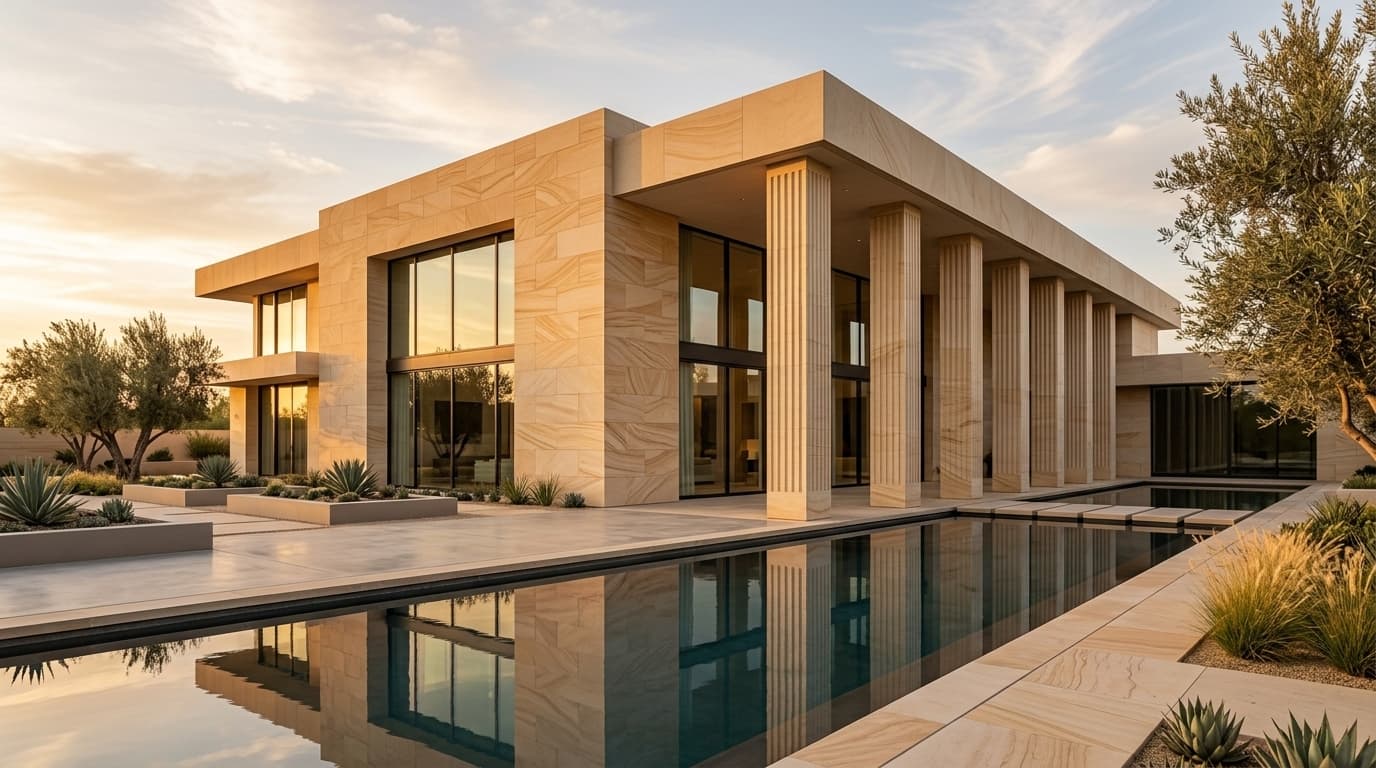
- When paired with sandstone wall cladding, Indian marble provides perfect visual and thermal equilibrium in luxury tropical and subtropical villas.
In the luxury residential design market, the choice of marble flooring is one of the most critical capital investments an architect or homeowner will make. For decades, clever marketing has positioned imported Italian marbles (such as Statuario, Calacatta, and Botticino) as the pinnacle of opulence. Yet, geotechnical laboratory tests and centuries of architectural evidence tell an entirely different story. In this objective material analysis, we evaluate the real engineering differences between authentic Indian natural marble and imported Italian marble.
1. The Geological Difference: Interlocking Recrystallization vs Fissured Marble
Indian marble (most famously Makrana, Rajnagar, and Ambaji) originates from the ancient Precambrian Aravalli mountain belt in Rajasthan. Subjected to intense regional metamorphism over 1.5 billion years, the rock's calcite crystals grew into a dense, tightly interlocked mosaic resembling crystalline sugar.
In contrast, Italian marbles from the Apuan Alps (Carrara region) are significantly younger (formed during the Jurassic period, ~190 million years ago). Due to milder metamorphism, Italian marble remains softer, with frequent micro-fissures (taroli) and microscopic voids between mineral grains.
Geotechnical Fact
Indian Makrana marble possesses a calcium carbonate (CaCO3) purity of 98.2%, making it virtually impervious to atmospheric moisture and sub-floor efflorescence.
2. The Resin-Netting Secret: Structural Monolith vs Mesh-Backed Slabs
A little-known trade reality of Italian marble is that almost every commercial slab requires an epoxy resin impregnation process and a fiberglass mesh glued to its backside (known as resin-netting) to prevent the slab from shattering during gang-saw slicing and overseas container shipping.
Indian marble is so structurally sound and cohesive that it is processed and installed without any fiberglass netting or vacuum resin filling. It is 100% solid, monolithic natural stone through its entire 18mm to 20mm thickness.
| Material Metric | Indian Makrana White Marble | Italian Statuario / Carrara |
|---|---|---|
| Geological Age | 1.5 Billion Years (Precambrian) | ~190 Million Years (Jurassic) |
| Water Absorption | < 0.15% (Ultra-dense) | 0.40% – 0.65% (High porosity) |
| Epoxy Netting Required? | No (100% Monolithic natural slab) | Yes (Fiberglass mesh backing mandatory) |
| Yellowing Susceptibility | Zero (Will never turn yellow) | High (Epoxy oxidation & cement moisture) |
| Thermal Comfort in Hot Climates | Cool to the touch all day | Absorbs ambient heat rapidly |
| Historical Track Record | Taj Mahal (400+ years pristine white) | Historic statues suffer acid rain pitting |
3. Porosity & Stain Vulnerability: Acid Reaction, Moisture & Yellowing
Because Italian marble has higher porosity, it acts like a dense sponge. Spilled turmeric oil, red wine, or wet bathroom dampness readily seep into the stone pores, causing deep permanent stains that cannot be ground out without thinning the slab.
Indian marble's ultra-dense crystal boundary limits fluid penetration to less than 0.5mm, allowing superficial surface blemishes to be easily polished out with fine abrasive pads.
4. The Polishing Longevity Test: Re-Polishing Every 3 Years vs Generation
Italian marble floors in high-traffic Indian homes typically lose their factory shine within 2 to 4 years, requiring costly and messy chemical re-crystallization with toxic fluorosilicate compounds.
Indian marble is polished purely through water and diamond abrasive discs. Because the gloss comes from the crystalline rock itself rather than a topical wax coat, daily barefoot traffic actually acts as a continuous natural buffer. Indian marble floors look more magnificent 30 years after installation than on day one.
5. Cost & Carbon Footprint: Quarry-Direct Indian Heritage vs Shipping
Importing Italian marble incurs colossal ocean freight fuel consumption, customs tariffs, and intermediary broker markups, driving costs to exorbitant levels without delivering superior durability.
By sourcing directly from certified Rajasthan quarry concessionaires like Garg Corporation Ltd., developers and estate owners obtain superior geotechnical performance, authentic heritage lineage, and minimal carbon footprint at direct factory pricing.
While Italian marble offers distinctive bold veining for vertical dry-clad feature walls, authentic Indian crystalline marble remains the uncontested champion for generational residential flooring, courtyard pavings, and high-traffic luxury estates.
Frequently Asked Questions
Why does Italian marble (like Statuario or Botticino) often turn yellowish after a few years of installation?
Italian marbles contain higher natural porosity (0.40% to 0.60%) and are heavily treated with epoxy resins and fiber mesh on the back during processing in Italian gang-saws. Over time, moisture from the cement-mortar sub-floor penetrates through the pores and reacts with the synthetic epoxy, causing chemical oxidation that manifests as ugly yellow or brownish patches. Indian Makrana marble contains virtually zero epoxy resin and possesses an ultra-dense crystalline structure (<0.15% porosity) that will never turn yellow.
Is Indian marble harder and more durable than Italian marble?
Yes. Indian marble quarried from Rajasthan's Aravalli range has undergone higher metamorphic temperature and pressure over 1.5 billion years, resulting in a dense, tightly interlocked saccharoidal calcite crystal matrix. It resists foot-traffic abrasion, hairline fracturing, and kitchen spills significantly better than softer, sediment-rich European marbles.
Can Indian marble achieve the same high-gloss mirror shine as Italian marble?
Indian marble can achieve an even higher, more enduring mirror shine. Unlike Italian marble which relies on superficial chemical polishing waxes that wear off in 2 to 3 years, Indian marble is polished mechanically using diamond grinding pads. Because the stone is pure calcite, friction from foot traffic naturally buffs the surface, meaning an Indian marble floor actually looks brighter and more lustrous with every passing decade.