Key Takeaways
- Multi-tiered classical fountains require precise horizontal lip leveling (+/-0.5mm) across tiered bowls to achieve an unbroken 360-degree sheet cascade of water.
- Monolithic fountain bowls chiseled from single blocks of fine-grained Dholpur Beige sandstone withstand hydraulic water pressure and winter freeze-thaw cycles without seam leaks.
- Inner water basins require transparent or matte elastomeric waterproofing membranes to seal microscopic rock capillaries while preserving the natural outer stone texture.
- Dedicated subterranean pump sumps with auto-fill float valves and multi-stage filtration prevent pump cavitation, leaf blockages, and unsightly mechanical clutter.
From the historical Charbagh paradise gardens of the Taj Mahal to the classical courtyards of European grand estates, water flowing over hand-carved stone is the pinnacle of luxury landscape design. The gentle, soothing sound of cascading water masks urban noise, while the tactile elegance of sculpted sandstone provides a magnificent sculptural centerpiece. In this comprehensive manual, we examine the fine intersection between traditional Shilpa Shastra stone sculpting and modern hydraulic engineering.
1. Heritage Lineage: Mughal Charbagh & Tiered Classical Fountains
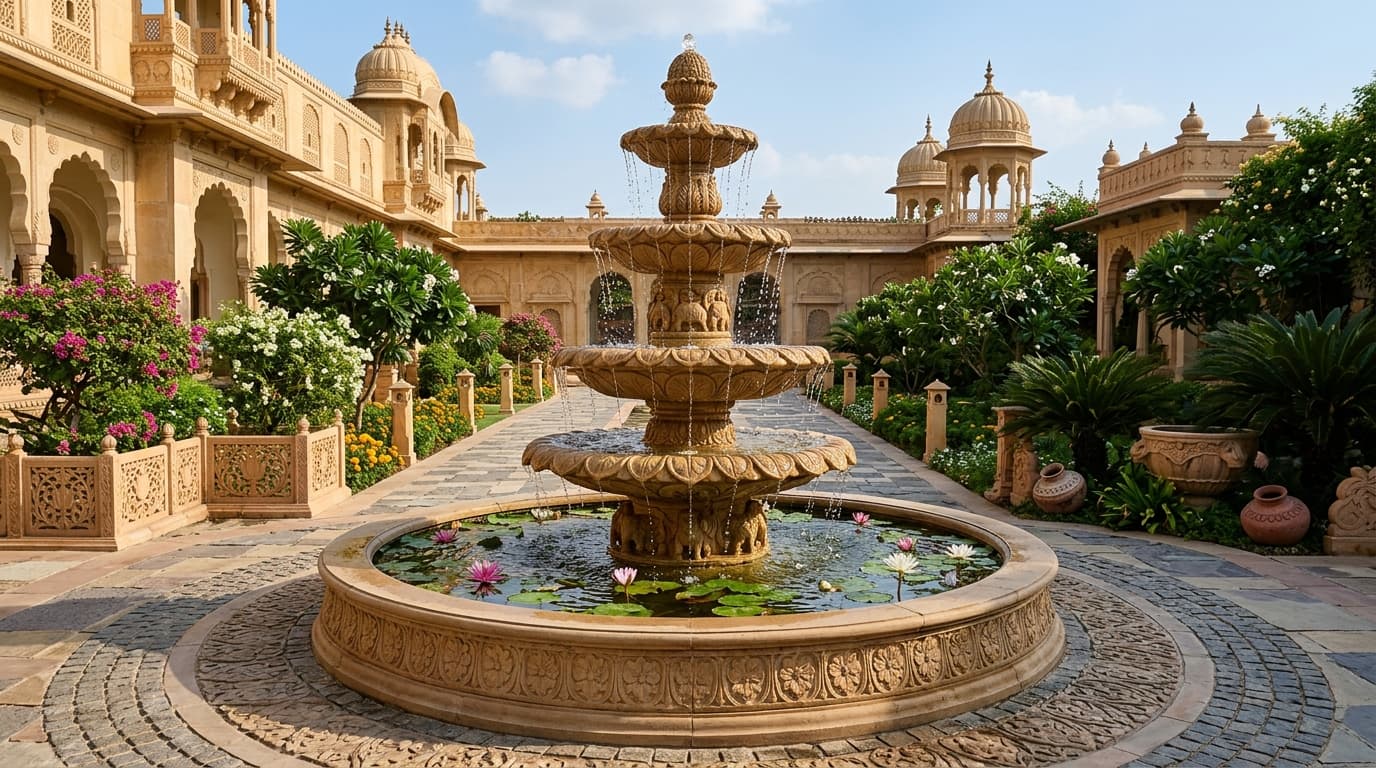
In Indian architectural tradition, water elements (Jala Yantras) are sacred representations of cosmic purity and cooling serenity. During the Mughal and Rajput golden eras, master stone carvers in Dholpur, Sikandra, and Agra crafted ornate fountains with scalloped lotus petals (Kamal-pushpa) that directed water into undulating sheets of mist.
Today, Garg Corporation Ltd. honors this generational heritage. Our master artisans carve monumental fountain sculptures ranging from 2-tiered intimate courtyard fountains to 5-tiered royal palace water features spanning over 6 meters in diameter.
Master Sculptor Secret
Traditional Sikandra stone carvers hand-chisel a microscopic 3mm undercut groove along the underside of every scalloped petal. This 'water break' forces surface tension to snap cleanly into vertical falling droplets instead of dribbling down the central column.
2. Artisan Sthapati Carving: Multi-Tiered Bowls, Lotus Motifs & Scalloped Lips
Unlike synthetic cast-stone or fiberglass replicas that feel hollow and degrade under outdoor weather, our fountains are chiseled from solid monolithic blocks of natural sandstone. Each bowl starts as a massive multi-tonne block of Dholpur Beige or Agra Red sandstone, hollowed out on heavy turntables and sculpted entirely by hand.
Artisans carve classical fluted acanthus leaves, lion-head water spouts, dancing peacock pedestals, and delicate petal rims. Because the stone is solid through-and-through, it will never crack from internal hollow voids or lose its sharp sculptural crispness.
| Fountain Scale & Bowl Diameter | Typical Tier Count | Recommended Pump Flow (LPH) | Subterranean Sump Volume | Center Supply Pipe |
|---|---|---|---|---|
| Intimate Patio (Ø 900mm - 1200mm) | 2 Tiers | 3,500 – 6,000 LPH | 150 – 250 Liters | 25mm (1 inch) Stainless Steel |
| Courtyard Centerpiece (Ø 1500mm - 2100mm) | 3 Tiers | 8,000 – 14,000 LPH | 400 – 750 Liters | 38mm (1.5 inch) Stainless Steel |
| Palace Grand Estate (Ø 2400mm - 3600mm) | 3 to 4 Tiers | 18,000 – 28,000 LPH | 1,200 – 2,500 Liters | 50mm (2 inch) Stainless Steel |
| Monumental Public Plaza (Ø 4000mm+) | 4 to 5 Tiers | 35,000 – 60,000 LPH | 4,000+ Liters (Dedicated plant room) | 75mm (3 inch) Stainless Steel |
3. Hydraulic Engineering: Flow Rate (LPH), Head Height & Silent Pumping
A magnificent fountain requires invisible, silent mechanics. A noisy vibrating pump or exposed black PVC pipes completely shatters the tranquil courtyard ambiance.
We design every fountain with an internal core-drilled conduit passing through the exact vertical center of the stone columns. Stainless steel grade 304 or 316 riser pipes are concealed inside. We recommend placing the pump inside a separate subterranean dry well or submerged basin sump equipped with a multi-stage stainless steel leaf basket filter and an automated brass float valve that automatically replenishes evaporated water.
4. Submerged Waterproofing & Capillary Sealing: Preventing Efflorescence
Constant submersion in water requires specialized chemical protection. While natural sandstone is durable, unsealed stone continuously absorbs water into its micro-pores. Over years of evaporation, dissolved airborne salts and calcium minerals can produce unsightly white calcification marks along the waterline.
We apply a state-of-the-art potable-water approved transparent elastomeric polyurea or hybrid polyurethane barrier to the interior submerged faces of each fountain bowl. This seals the pores 100% against moisture penetration while leaving the exterior carved stone face in its pristine natural tactile state.
5. Winterizing & Algae Prevention: Long-Term Maintenance Protocols
To prevent green and black algae blooms without harsh chemical chlorine that could discolour natural stone, we recommend non-copper, biodegradable ionic water clarifiers or inline submerged UV sterilizer lamps integrated into the pump filtration circuit.
In regions subject to severe freezing winter temperatures, fountains must be winterized: all water should be drained through built-in brass drain plugs, internal riser pipes blown dry with compressed air, and a breathable waterproof canvas cover secured over the tiers to prevent freezing water expansion from cracking the bowls.
A hand-carved natural sandstone water fountain is a multi-generational legacy that anchors the spirit of an estate. Whether commissioning a bespoke Mughal Lotus fountain or a classical Roman tiered masterpiece, Garg Corporation Ltd. collaborates with architects worldwide to sculpt and engineer extraordinary water features.
Frequently Asked Questions
How do you achieve an even, symmetrical sheet of water cascading from every side of a tiered fountain bowl?
Uneven water cascading occurs when fountain tiers are installed out of level by even 1 millimeter, or when bowl lips have uneven lip depths. Our master stone sculptors carve a continuous micro-drip groove (water break) under each tiered lip, and our installation engineers use precision digital spirit levels and brass leveling shims during on-site pedestal assembly to ensure the bowl circumference is level to within +/-0.5mm.
Does continuous water exposure cause natural sandstone fountains to crumble or develop white salt stains?
White mineral staining (efflorescence) occurs when water seeps through porous stone capillaries and dissolves free calcium salts in cement mortar beds. We eliminate this by: (1) Using ultra-dense, low-absorption Dholpur Beige siliceous stone; (2) Sealing internal water-bearing bowls with potable-grade polyurethane waterproofing elastomeric barriers; and (3) Using epoxy-based non-efflorescing assembly mortars.
What size pump is required for a large 3-tiered estate courtyard fountain?
Pump sizing is determined by the total weir length (combined circumference of all cascading bowl lips) and vertical dynamic head height. As an engineering rule of thumb, cascading fountain bowls require approximately 120 to 150 liters per hour (LPH) per centimeter of weir width. A 3-tiered fountain with a 1.2m top bowl and 2.5m lift height typically requires a commercial submersible pump rated at 15,000 to 20,000 LPH with adjustable variable-frequency drive (VFD) flow control.